


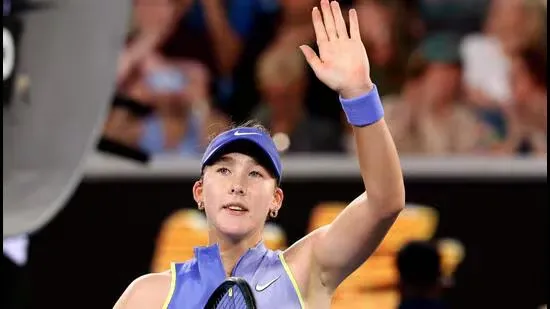
At just 18 years old, Mirra Andreeva is quietly crafting one of the most compelling journeys in modern women’s tennis. Her commanding 6-0, 6-4 victory over former world number three Maria Sakkari at the Australian Open added another milestone to a rapidly growing résumé and underlined why she is increasingly viewed as a future Grand Slam champion.
The win marked Andreeva’s eighth career singles victory at the Australian Open, the highest tally by any active teenage player on the WTA Tour. Since the year 2000, she has become only the fourth player to record 30 or more Grand Slam singles wins before turning 19, joining an elite group that includes Maria Sharapova Nicole Vaidisova and Coco Gauff. The statistic alone places her among rare company, but her story goes far beyond numbers.
Currently ranked world number seven, Andreeva’s rise has been built on consistency rather than sudden breakthroughs. Unlike some teenage sensations who arrive with shock results and struggle to maintain momentum, the Russian teenager has steadily climbed the rankings while strengthening every aspect of her game. Her progression from WTA debut in 2022 to the top 50 in 2023 and the top 20 in 2024 reflects a carefully managed ascent.
The contrast with other young stars is striking. Emma Raducanu’s remarkable US Open triumph in 2021 came as a qualifier, but injuries form issues and constant coaching changes have made sustained success elusive. Coco Gauff, despite already winning Grand Slam titles, continues to refine areas of her game. Andreeva’s journey sits somewhere in between, shaped by patience experience and a clear sense of belonging at the elite level.
Her breakthrough moment arrived last season at Indian Wells, where she became the youngest WTA 1000 champion in history. That title run included victories over Aryna Sabalenka Iga Swiatek and Elena Rybakina, a trio that defines the very top of the women’s game. Few players at any age can claim wins of that calibre in a single tournament.
Under the guidance of former Wimbledon champion Conchita Martinez, Andreeva has developed a complete all-court game capable of troubling even the world number one. She has already beaten Sabalenka twice and consistently shows tactical awareness well beyond her years. More importantly, she has learned to cope with setbacks. Semi-final and quarter-final appearances at recent majors have come alongside tough losses, experiences that have contributed to her mental growth.
Late in 2025, a difficult run during the Asian swing tested her resilience. Frustration was visible, but instead of derailing her season, it became a learning phase. Extended pre-season work focusing on mindset and game refinement helped reset her approach. That transformation was evident in Melbourne, where she remained composed even when momentum briefly shifted against Sakkari in the second set.
Andreeva herself summed it up best when she spoke about feeling like a different player compared to just a few months earlier. With an Adelaide title already under her belt heading into the Australian Open, confidence and clarity now define her performances.
While she is yet to lift a Grand Slam trophy, the foundations are firmly in place. If her development continues on this trajectory, the question may not be if Mirra Andreeva wins a major, but when. At the Australian Open 2026, she is not just competing — she is announcing that her time at the very top is approaching.