


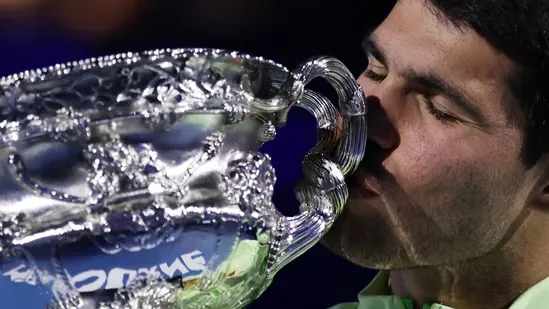
Carlos Alcaraz’s triumph at the 2026 Australian Open was more than another Grand Slam victory. It marked a defining moment in modern tennis history and ignited a serious conversation about long-term greatness. By lifting the trophy in Melbourne Alcaraz completed a career Grand Slam secured his seventh major title and achieved a milestone no male player before him had reached at such a young age.
At 22 years 8 months and 27 days Alcaraz defeated Novak Djokovic in a four-set final turning around a difficult opening set to win 2-6 6-2 6-3 7-5. The victory denied Djokovic a record-extending 25th Grand Slam and delivered Alcaraz the only major title missing from his collection. More importantly it confirmed that his success is not limited to one surface one season or one tactical style. His dominance travels across conditions opponents and pressure moments.
What elevates this achievement is not just the number of titles but the speed and completeness of the journey. From his first ATP Tour main-draw win in February 2020 to completing the career Grand Slam in early 2026 Alcaraz needed just over six years. This accelerated rise sets him apart from every past legend. While Roger Federer Rafael Nadal and Novak Djokovic each built greatness on different timelines Alcaraz has combined early explosiveness with immediate all-surface mastery.
A direct age-based comparison sharpens the debate further. At the same age Nadal had six Grand Slam titles Federer had two and Djokovic had one. Alcaraz already stands at seven with victories spread across all four majors. This places him ahead of the Big Three curve not as a projection but as a statistical reality.
However history shows that greatness in tennis is not defined by early dominance alone. Longevity endurance and the ability to evolve determine who ultimately stands alone. Federer Nadal and Djokovic extended their legacies by winning deep into their thirties proving that physical management tactical reinvention and mental resilience matter as much as raw talent. For Alcaraz the challenge now shifts from arrival to survival at the top.
Djokovic’s continued presence also reshapes the competitive landscape. As the Serbian legend nears the end of his career the tour is likely to become more volatile with multiple contenders capable of peaking at major events. If Alcaraz continues to collect titles in such an environment his case for historical greatness will only strengthen as it would reflect dominance over an era rather than a rivalry.
Looking ahead Alcaraz’s career could follow multiple paths. He may remain elite through his twenties and taper naturally still finishing among the sport’s all-time greats. He could experience injury-driven turbulence yet continue winning across surfaces into later years. Or he could manage his body and game with Djokovic-like precision opening the door to record-challenging numbers. Each path remains possible but his current position keeps every ceiling mathematically open.
What separates Alcaraz from hype-driven comparisons is the depth of his game. He wins with variety intelligence and adaptability. His Australian Open final was a clear example as he absorbed early pressure adjusted his return strategy tightened his margins and turned the contest into a physical and tactical battle that favored him. These are not flashes of brilliance but signs of a player built for sustained excellence.
After Melbourne 2026 it is reasonable to say tennis is witnessing the making of something historic. Alcaraz has proven he can win everywhere and against anyone. Whether he becomes the greatest of all time will not be decided by what he has already achieved but by how long he can remain hungry resilient and evolving at the top of the sport.