


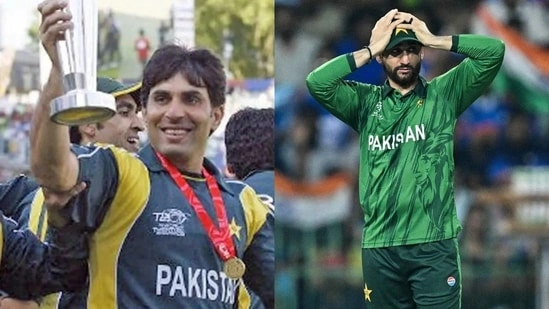
Seventeen years can redefine a cricketing identity and for Pakistan the gap between 2009 and 2026 feels less like evolution and more like erosion. The fearless T20 World Cup winners of 2009 were a side built on clarity aggression and intent. The current 2026 squad by contrast appears cautious role-blurred and uncertain carrying the same badge but none of the same menace.
In 2009 Pakistan played T20 cricket on their own terms. They dictated tempo hunted wickets relentlessly and trusted impact over reputation. The World Cup final was a textbook example as Pakistan chased 139 with purpose using Shahid Afridi as an early disruptor Kamran Akmal as momentum at the top and Shoaib Malik as the closer. Even Younis Khan not batting was proof of depth rather than dependence.
Fast forward to 2026 and the picture is starkly different. Against India Pakistan were bundled out for 114 in 18 overs a performance marked by hesitation and the absence of a clear plan. Instead of forcing the game forward this side waits hoping pressure will ease on its own. That mindset defines the regression.
The 2009 team was stacked with match-winners who could decide games in a handful of deliveries. Umar Gul Saeed Ajmal and Mohammad Amir formed a wicket-taking machine that thrived on fear not containment. Every over threatened collapse for the opposition. In contrast the 2026 attack has skill but not intimidation. Shaheen Afridi Shadab Khan Mohammad Nawaz and Abrar Ahmed look strong on paper yet too often allow momentum overs that release pressure. Conceding 175 on a surface where 140 was competitive underlined the absence of a biting bowling strategy.
Batting tells an even harsher story. The 2009 lineup embraced chaos with defined roles. Afridi was a leverage batter Malik the stabiliser and finishers like Misbah-ul-Haq and Abdul Razzaq provided insurance. The current side is crowded with similar profiles that value stability over inevitability. Captain Salman Ali Agha at number three lacks the strike power required for modern T20 cricket while Babar Azam despite his class struggles to impose himself in high-impact scenarios.
Position by position the trade-offs are evident. Kamran Akmal’s volatility once terrified bowlers while today’s openers offer steadiness without fear. Shoaib Malik’s versatility has no true modern equivalent. Where 2009 had finishers who could rescue any chase 2026 has contributors who rarely dominate.
Leadership may be the biggest separator. Younis Khan’s captaincy was about control and execution. His team followed a script squeeze strike surge finish. Salman Ali Agha’s tenure feels reactive marked by uncertainty both in tactics and tone. When a captain cannot reliably set tempo with the bat the entire side plays in hesitation mode.
This is not merely a change in personnel. It is a shift in philosophy. Pakistan’s 2009 side knew what it was and played accordingly. The 2026 team is still searching for an identity in a format that punishes doubt. Until intent returns along with clear roles and fearless leadership Pakistan’s T20 past will continue to overshadow its present.