


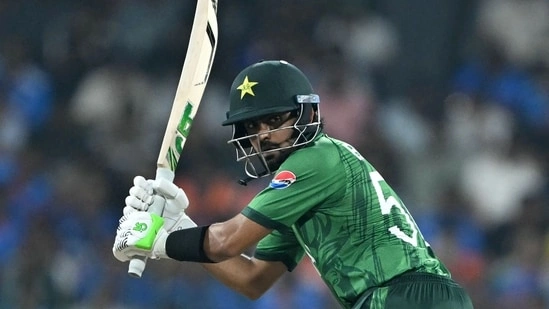
Former England captain Michael Vaughan has stirred debate around Pakistan’s team selection by suggesting that Babar Azam cannot be dropped due to internal politics and is being strategically used by head coach Mike Hesson as a safety net during the T20 World Cup 2026. Vaughan’s comments came after Babar endured another difficult outing with the bat raising fresh questions about his role in Pakistan’s playing XI.
Babar Azam recorded a modest 25 off 24 balls while batting at number four in Pakistan’s Super 8 clash against England. The innings further pushed his tournament strike rate down to 111.5 now the lowest by any batter in T20 World Cup history. Despite the criticism Vaughan believes Hesson has managed the situation smartly by adjusting Babar’s role rather than excluding him altogether.
Speaking during a discussion Vaughan said that overseas coaches working in Pakistan face unique challenges and selection decisions are often influenced by factors beyond performance alone. According to him Hesson has accepted that Babar must play and has therefore positioned him as an insurance option who can steady the innings if early wickets fall.
Vaughan also pointed out that conditions matter greatly when assessing Babar’s value. He feels the former Pakistan captain is well suited to Sri Lankan pitches where totals usually fall in the 150 to 180 range. On such surfaces Babar’s ability to rotate strike and handle spin could help Pakistan reach competitive scores around 160 or 170. However Vaughan was clear that on flatter tracks demanding scores above 200 Babar no longer fits the role of an aggressive match winner.
The former England batter praised Hesson for navigating the political landscape while still trying to balance the team’s needs even if it may not provide the best chance of winning the World Cup outright. He added that on slower pitches like those expected in Pallekele a steady presence such as Babar in the middle overs can be crucial provided other batters play impactful cameos around him.
Statistically Babar’s T20 World Cup numbers remain under scrutiny. His career strike rate in the tournament now sits below that of players like Mohammad Hafeez Kumar Sangakkara and Kane Williamson. Across 23 World Cup matches he has scored 640 runs at an average of 33.68 with five half centuries. In the current edition he has managed only 91 runs from six matches at an average of 22.75 adding to the growing debate over his role in Pakistan’s T20 setup.