


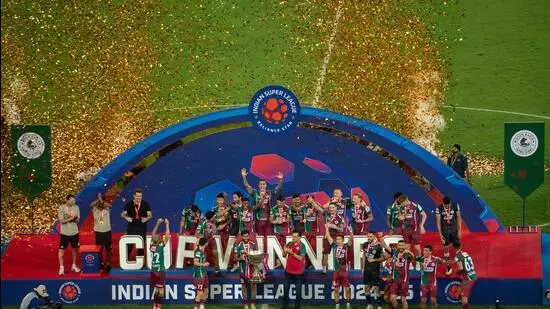
A new proposal from Football Sports Development Limited (FSDL) suggests a significant structural shift in Indian football, potentially locking the Indian Super League (ISL) into a closed format without promotion or relegation for the next 10 years. The plan also recommends a five-year pause on league expansion and introduces a joint ownership model between the All India Football Federation (AIFF), ISL clubs, and FSDL.
Outlined in a 22-page draft titled ISL Way Forward, the proposal was submitted to AIFF in March amid discussions to renegotiate the commercial agreement set to expire mid-2025. Under the new model, ISL and national team match rights would be governed by a separate autonomous company, with stakes distributed as 60% to ISL clubs, 26% to FSDL, and 14% to AIFF. This entity would retain perpetual rights over India’s top-tier football and international fixtures, with FSDL maintaining veto powers on key decisions.
The draft contradicts the roadmap agreed with the Asian Football Confederation (AFC) in 2019, which mandated relegation to begin by the 2024–25 season. As part of the existing pathway, I-League champions have been granted ISL entry, with Punjab FC and Mohammedan Sporting already qualifying. Should the new proposal be accepted, upcoming I-League winners—including those awaiting judgment at the Court of Arbitration for Sport—may find themselves excluded from ISL entry in the 2025–26 season.
Additional conditions include a requirement for clubs to maintain consistent ownership for five years before qualifying for promotion, alongside meeting financial, licensing, and performance standards.
The proposal also seeks to dissolve the current Master Rights Agreement, through which AIFF receives ₹50 crore annually—a fund that primarily supports Indian football activities outside the ISL. Instead, profits and losses from the new governing entity would be shared based on ownership stakes.
Former national team captain and current AIFF Executive Committee member Bhaichung Bhutia questioned whether AIFF properly evaluated its assets before engaging FSDL. As a result of his concerns, a review committee was established to conduct due diligence and engage further with commercial stakeholders.
Anonymous sources within the federation and ISL clubs indicate that discussions have stalled due to the case being sub-judice in the Supreme Court. Meanwhile, FSDL officials have expressed uncertainty over whether the inclusion of I-League clubs has enhanced ISL’s competitiveness or commercial value, suggesting the need to strengthen grassroots and lower-tier football structures before fully integrating promotion and relegation.
The document positions this governance shift as aligning with best practices in global football, citing European leagues, Japan, South Korea, Qatar, and Saudi Arabia as examples. It emphasizes the importance of collaborative policymaking, aiming for improved management of India’s top football league.
No official statement from FSDL has been issued, though club representatives confirm the organization is awaiting AIFF’s response. The debate continues over how best to balance growth, competitiveness, and long-term sustainability within Indian football’s evolving landscape.