


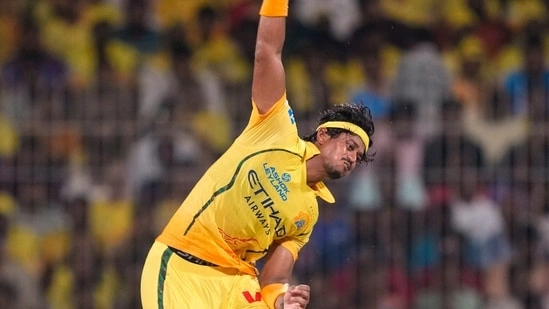
Ramakrishna Ghosh made a striking first impression in the Indian Premier League, not through headline-grabbing figures alone but through exceptional value generation for Chennai Super Kings. In a match where CSK defeated the Mumbai Indians by eight wickets at MA Chidambaram Stadium, Ghosh’s performance quietly stood out from a financial and impact perspective.
Though his match figures read three overs, one wicket, and one catch, the underlying contribution told a much bigger story. Valued at a season price of ₹30 lakh, his per-match cost was estimated at ₹5 lakh. Against this, his overall contribution translated into a match value of ₹47.84 lakh, resulting in a remarkable profit of ₹42.84 lakh for CSK.
This means Ghosh delivered a recovery rate of 956.8 percent on his debut — an extraordinary return, especially for a newcomer. Put simply, for every ₹1 invested in his match cost, CSK received nearly ₹9.57 in value.
His impact wasn’t just numerical. With the ball, Ghosh played a key role in halting Mumbai’s momentum during the middle overs. He dismissed Suryakumar Yadav at a crucial stage when the batter looked set to accelerate. At 99 for 2, Mumbai had the platform to push beyond 170, but that wicket disrupted their plans and kept the total in check at 159 for 7.
Earlier, Ghosh had already contributed in the field by taking a catch to dismiss Will Jacks, giving CSK an early breakthrough. His all-round involvement added depth to his overall performance score, combining both bowling control and fielding sharpness.
While the chase was comfortably handled by Ruturaj Gaikwad and Kartik Sharma, who ensured a smooth finish, the groundwork laid earlier helped keep the target manageable.
What makes this debut particularly significant is the balance between cost and output. Unlike high-value players who need standout performances to justify their price, lower-cost players like Ghosh can generate massive returns with impactful contributions in key moments. His wicket, disciplined bowling spell, and sharp fielding created a wide gap between cost and performance — a gap that translated into tangible profit for CSK.
By the end of the match, the numbers painted a clear picture: ₹5 lakh invested, ₹47.84 lakh generated, and ₹42.84 lakh gained as profit. For CSK, this wasn’t just a promising debut — it was a high-efficiency performance that highlights the importance of smart squad depth in a long tournament.