


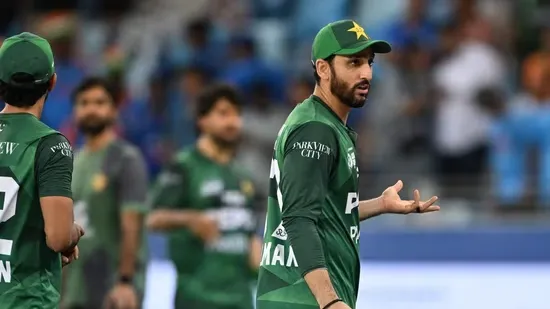
Former Indian cricket legend Sunil Gavaskar has strongly criticized Pakistan skipper Salman Ali Agha for refusing to attend the post-match presentation after the Asia Cup 2025 Group A clash between India and Pakistan at the Dubai International Stadium. The high-voltage encounter saw Suryakumar Yadav’s Indian side secure a comfortable seven-wicket victory while chasing down a modest 128-run target with more than four overs to spare.
The contest, however, was overshadowed by a major controversy after India’s players declined to engage in the customary post-match handshakes with their Pakistani counterparts. Reports suggest that Salman Agha and Pakistan coach Mike Hesson attempted to meet the Indian players in their dressing room for a handshake, only to find the door closed. Upset with the incident, Agha chose to skip the official post-match presentation hosted by Sanjay Manjrekar.
Gavaskar was unsparing in his criticism, noting that the absence of the losing captain made little difference to fans and broadcasters. “Nobody wanted excuses anyway. The focus was on hearing from the winning captain. People are more interested in the thoughts of the match-winner than justifications from the defeated side,” he told India Today.
India captain Suryakumar Yadav, meanwhile, dedicated the team’s emphatic victory to the Indian Armed Forces, paying tribute to victims of the Pahalgam terror attack. Gavaskar supported Yadav’s stance, saying politics and sports have often intersected historically and that individual players have every right to act according to their conscience.
The handshake issue has since escalated into a full-blown dispute, with the Pakistan Cricket Board (PCB) filing an official complaint with the ICC. The PCB has demanded the removal of the match referee from the tournament and even threatened to withdraw from the Asia Cup if its demands are ignored.
Gavaskar, however, stressed that there is no rule mandating post-match handshakes. “If a player chooses not to shake hands because of abuse or heated exchanges on the field, it’s entirely their personal decision,” he remarked. “It’s not compulsory, and no one should be forced to do something they’re uncomfortable with.”
With the controversy continuing to stir debates across the cricketing world, the Asia Cup faces further uncertainty, even as India’s dominant performance solidifies their standing in the competition.