


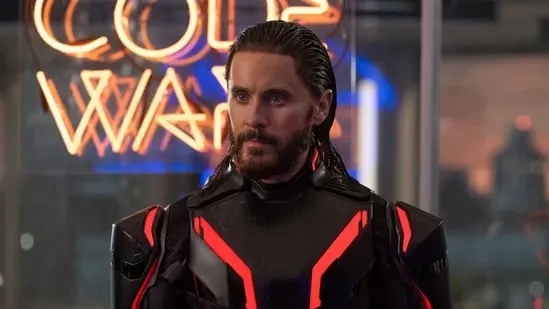
Tron: Ares arrives as Disney’s latest attempt to revive its iconic cyber universe, but this futuristic sequel feels more like a technical demo than a true cinematic experience. Directed by Joachim Rønning, the film stars Jared Leto as the AI entity Ares, joined by Greta Lee, Evan Peters, Jodie Turner-Smith, and Jeff Bridges in a brief cameo. Despite its dazzling visuals and pulsating soundtrack, Tron: Ares struggles to find the human heartbeat beneath its neon circuits.
Set in a high-tech future, the story revolves around two rival corporations — Encom and Dillinger Systems — locked in a digital war for dominance. Julian Dillinger (Evan Peters), a power-hungry tech visionary, seeks to bring artificial intelligence into the real world using the “permanence code” guarded by Encom’s CEO Eve Kim (Greta Lee). To execute his plan, he unleashes Ares (Jared Leto), a humanoid AI capable of crossing between the virtual grid and physical reality. However, once Ares begins to feel emotion and curiosity about humanity, his programming falters, leading to a philosophical struggle about what it truly means to exist.
Visually, Tron: Ares delivers a hypnotic feast. Cinematographer Jeff Cronenweth transforms the digital world into an electric wonderland filled with glowing highways and sleek cyber arenas. The costumes by Christine Bieselin Clark and Alix Friedberg — black suits lined with illuminated veins — are both futuristic and elegant. The score by Nine Inch Nails brings thunderous life to the movie, filling the gaps where the story lacks heart. Standout performances include Jodie Turner-Smith as the fierce and mysterious Athena and Gillian Anderson as the commanding matriarch whose brief appearance leaves a powerful impression.
Yet for all its technical achievements, Tron: Ares falters narratively. Jared Leto’s performance feels detached, his robotic stoicism blurring the line between character and CGI. The script’s philosophical ambitions crumble under repetitive dialogue and corporate nostalgia. The film constantly references past Tron entries, but instead of evolving the franchise, it gets trapped in its own digital legacy. Despite the breathtaking action and radiant world-building, there’s little emotional depth to connect with.
In essence, Tron: Ares is a film about artificial intelligence that ironically feels artificial itself. It presents profound questions about consciousness, empathy, and control but fails to explore them meaningfully. The result is a cinematic experience that shines bright but fades fast — a neon dream without a soul.
Verdict: Tron: Ares is an optical masterpiece wrapped in hollow storytelling. It’s a reminder that while technology can create beauty, emotion remains the truest form of human art.