


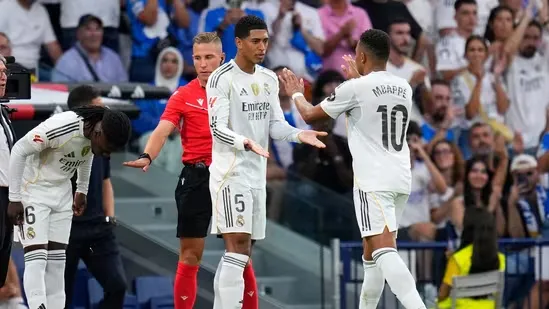
Real Madrid once again decided not to attend the 2025 Ballon d’Or ceremony, marking the second straight year the Spanish club has boycotted football’s most prestigious awards night. The absence of Los Blancos comes amid a growing rift with UEFA and the award organizers, rooted in a dispute that began in 2024.
At this year’s gala, PSG star Ousmane Dembélé lifted the Ballon d’Or, ahead of Barcelona’s Lamine Yamal and teammate Vitinha, while no Real Madrid player featured in the top three. Many speculated this could be the reason behind the boycott, but the issue goes deeper than individual recognition.
The Background of the Dispute
The conflict dates back to October 2024, when Real Madrid withdrew from the Ballon d’Or event after learning Vinícius Júnior would not receive the award, which instead went to Manchester City’s Rodri. Club president Florentino Pérez strongly criticized the organizers, stating that the Ballon d’Or and UEFA “do not respect Real Madrid,” and emphasized that the club would not participate where it feels undervalued.
Reports suggest Pérez believes UEFA influenced the 2024 voting outcome due to Madrid’s support for the European Super League project. Since then, attempts at reconciliation have failed. Even though France Football sent representatives to Madrid to mend relations before the 2025 ceremony, the club had already decided to maintain its boycott.
Real Madrid’s Missing Stars
The club’s absence was notable, given that several players were nominated: Vinícius Júnior, Kylian Mbappé, Jude Bellingham, and Thibaut Courtois (for the Yashin Trophy), as well as Dean Huijsen (for the Kopa Trophy). None of them traveled to Paris for the ceremony, highlighting the seriousness of the boycott.
Institutional Pride Over Individual Awards
Although Real Madrid faced Levante just 24 hours after the event, the scheduling challenge appeared secondary to the broader principle. The boycott underscores how the club prioritizes its institutional pride and narrative over the recognition of individual stars.
The standoff sets an important precedent: Real Madrid’s absence signals that disputes between elite clubs and governing bodies can overshadow even the most prestigious individual honors. As the conflict extends into a second year, it shows no signs of resolution, reshaping the relationship between Real Madrid, UEFA, and global football awards.